Beyond Tools: Building Coherence OS
Our students and educators are already navigating complex systems. Different programs, platforms, and assessments all compete for attention. Tools that aren't centered in the actual experience of teachers and students risk making that complexity worse. At Teaching Lab Studio, our Fellows are committed to designing tools that create coherence and we know tools are just one piece of the puzzle.
We deeply believe that AI can transform teaching and learning. But to understand that vision, we have to see past the tools and see what the technology can allow schools to be for students.
Welcome to Coherence OS
At the AI Revolution Lab at the ASU+GSV Summit in April, participants got to experience our Studio tools and imagine a world where those tools “talked” to each other. Wouldn't it be cool if coaching action steps from Nisa could feed into the Relay Teaching Simulator to create personalized practice opportunities? What if Coteach knew a teacher was working on supporting multilingual learners and could design a small group lesson with that skill in mind?
We revealed our first prototype at the AI Revolution Lab: Coherence OS.
Coherence OS is an orchestration layer for teachers. It knits together the tools a school system already uses, surfaces live student data, and makes strategic instructional recommendations tailored for that teacher and their students. It puts teachers in the driver's seat to best use their time and talent to drive outcomes for students. At the end of the session, one participant came up to me and said, simply: "Mind blown."
What We Built and What We Learned
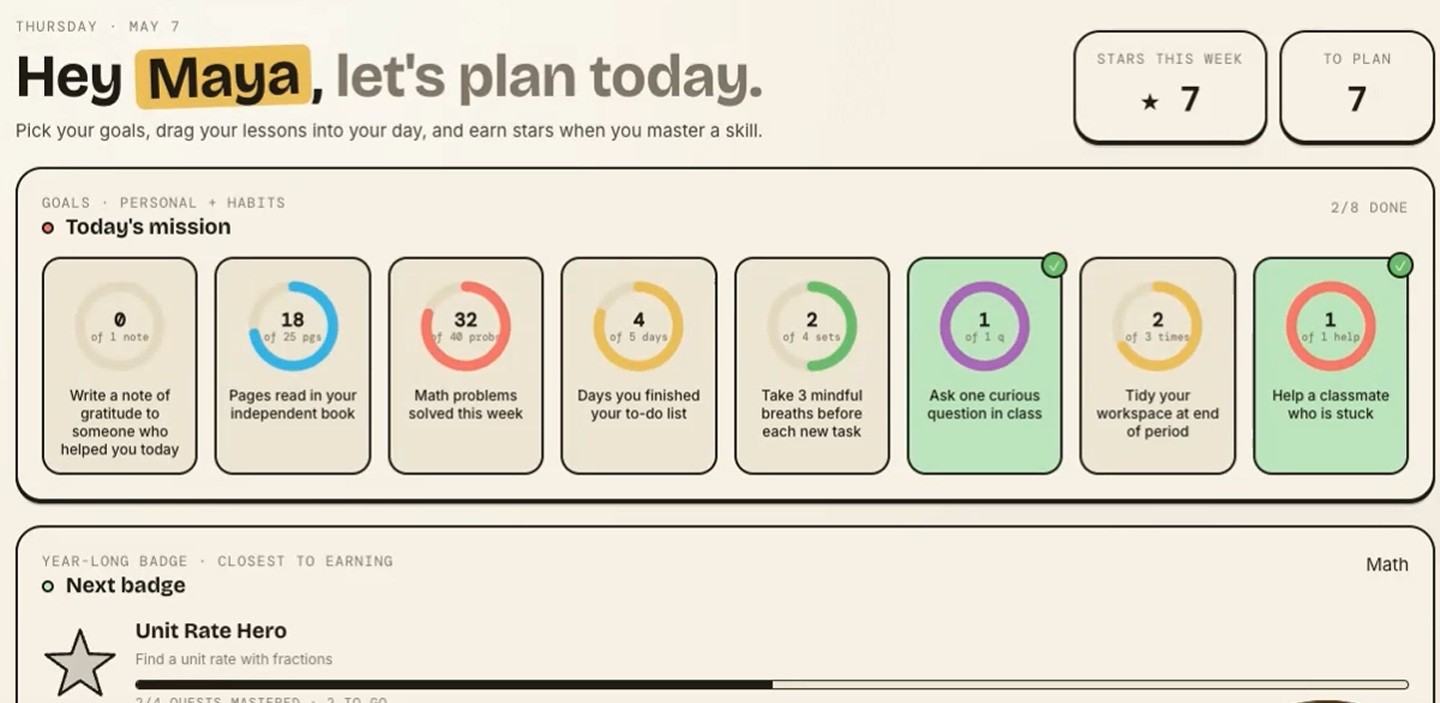
Since ASU+GSV, we have iterated on the prototype and have decided to first start with a student-facing version. Starting with a student’s view helped us understand what the teacher's view needed to look like and, ultimately, what a school leader version could be. You can watch the demo below.
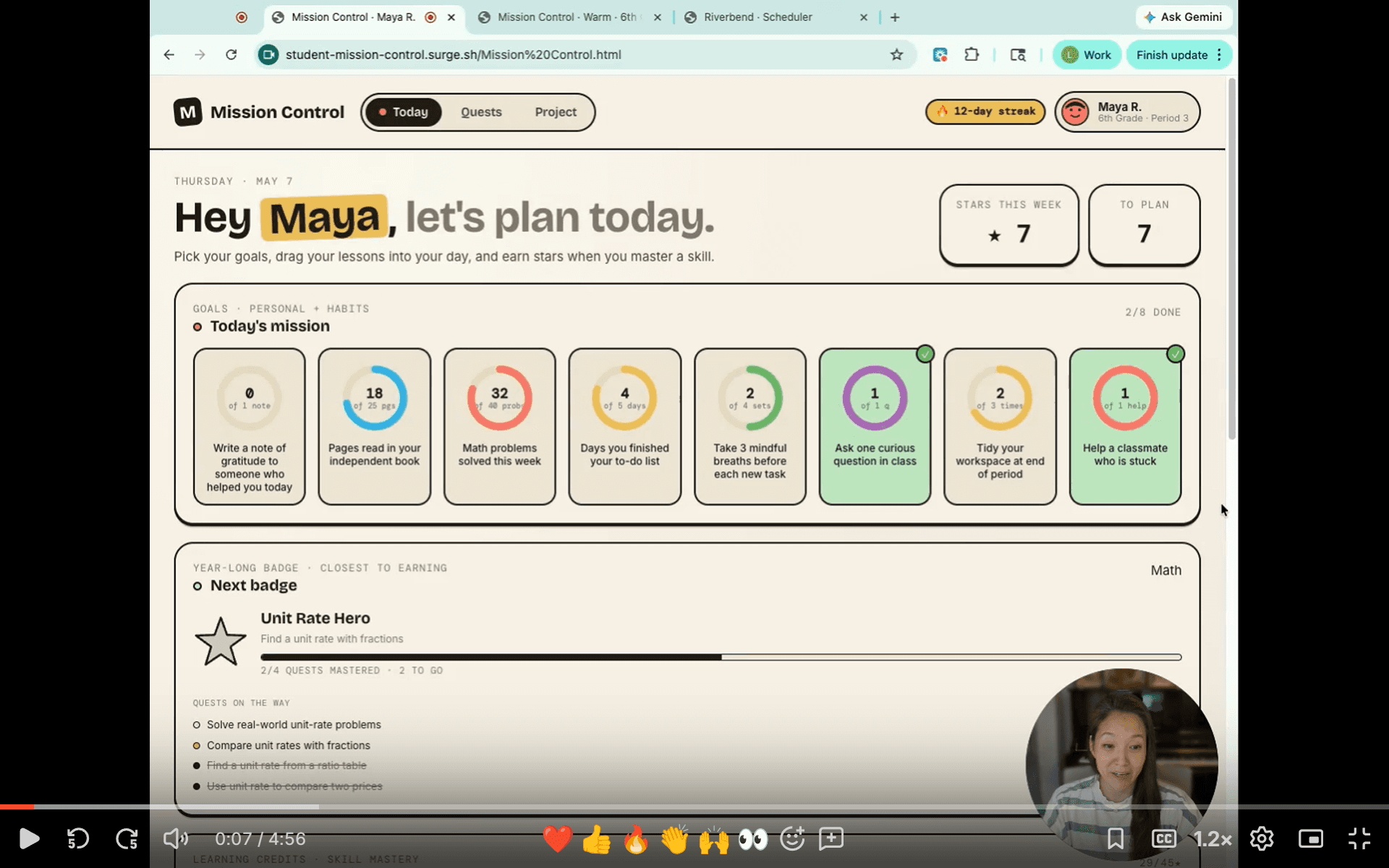
Building the student-facing view underscored three key learnings for us.
Start with the school model, not the platform. In the prototype, our student Maya had flexibility to schedule parts of her day but the fixed parts could change daily. Those are decisions baked into the school model. The school model determines what teachers need to see and do, which determines what leaders need to see and do. You can't design the tool without first designing the experience.
The platform is the easier part. The playlist is the hard part. As a former CAO, I was immediately blown away by Coherence OS because the engineering seemed impossible to me. Then I learned to vibe code on Claude Code and within a day, I had built the three versions of the Coherence OS interfaces. It made me realize that in the age of AI, platform creation is not the hard part. The hard part is the teaching and learning underneath.
For Coherence OS to truly work so that it’s not simply an AI-lite glorified dashboard, the lessons students are assigned daily have to be the right ones. The dynamic sequence of lessons have to be responsive to student work and thinking and produce the fastest growth from where a student is to where they need to be. For students starting two or three grade levels behind, the acceleration playlist algorithm has to be correct. We're still doing tons of R&D on learning velocity, and no tool can honestly claim to have cracked this yet in a way that we can confidently say yields equivalent outcomes to some of our strongest teachers. Teaching, learning, and learning science are the core of Coherence OS and we have to get that right. That is the true transformational innovation.
Relationships still drive learning. Designing the student version pushed me to envision an AI-powered school that is still fundamentally driven by human connection. A school where students are on computers all day is not what we're building toward. Learning happens in the context of relationships, and AI doesn't have to mean infinite screen time. Building these prototypes helped me think more expansively about what the underlying technology can actually make possible (i.e. more peer-to-peer learning) and what it should never replace.
What's Next
We're currently working across two streams: going back to the roots of teaching and learning to better understand how to maximize learning velocity, especially in math, and integrating sandboxed data from both AI tools and traditional online learning platforms into Mission Control to ensure that Coherence OS can integrate multiple tool-agnostic data sources to then perform a set of procedures.
Most importantly, we're launching with our School Model Fellowship schools in Fall 2026. Through the Fellowship, we will be designing, testing, and iterating Coherence OS alongside teachers and leaders because that's the only way we know we’re going to get this right.
We'll keep sharing what we learn as we start the next phase of our journey here at Teaching Lab Studio.