What if students built math games for each other?
Seven middle schoolers built real math games in six weeks

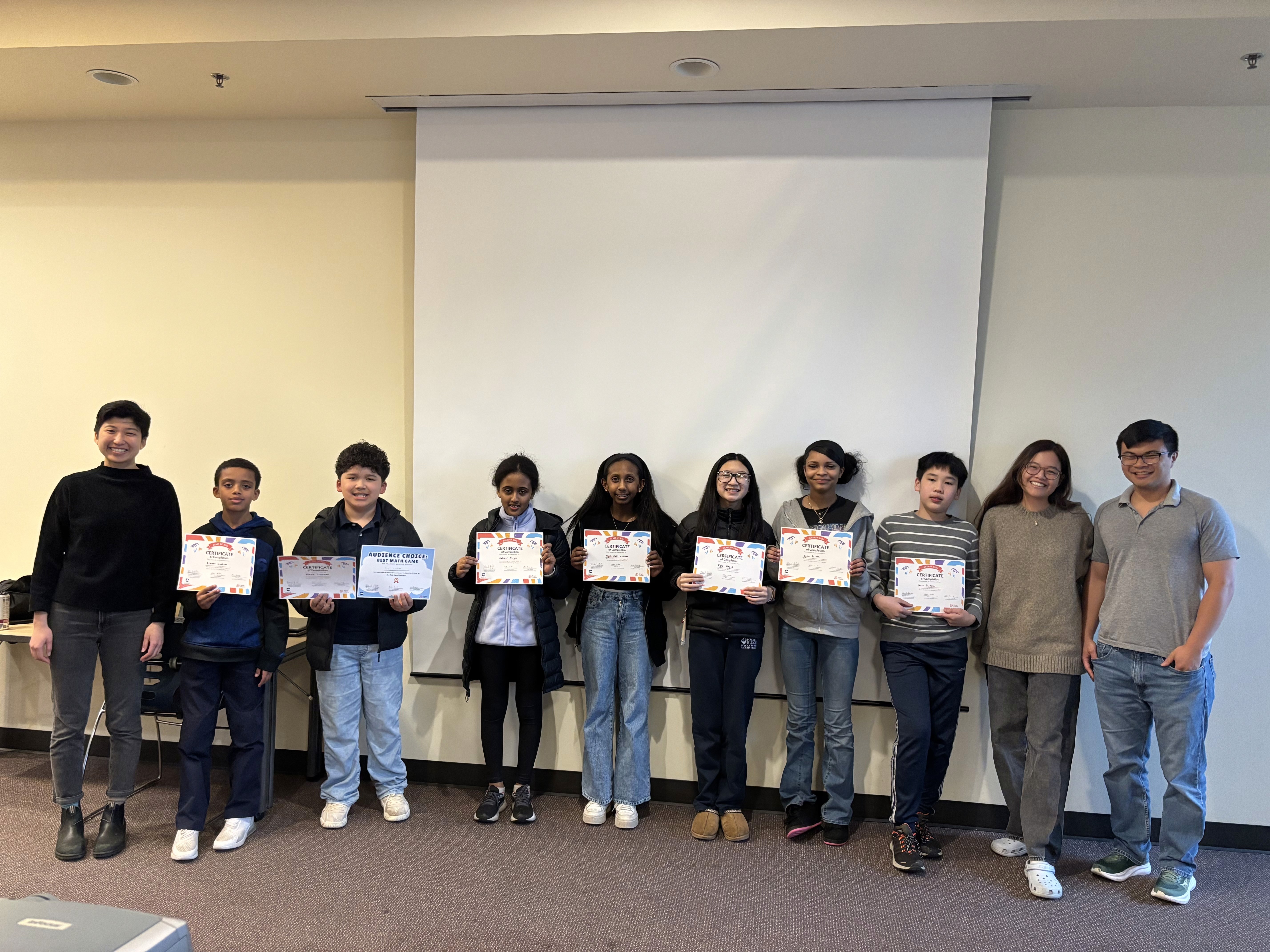
Most math games are built for students, not by them. These games dress math up in themes, characters, and rewards, but the math itself is still something to get through rather than something to genuinely engage with. What if we gave students the steering wheel?
Not long ago, building a video game required years of coding experience. However, with the emergence of AI-powered vibe coding platforms, anyone can describe what they want their game to look like and watch it come to life in minutes. This winter, the Tangle & Thrive team partnered with Rainier Scholars, an academic enrichment program in Seattle, to give students the opportunity to create their own math games.
How did it work?
Seven 6th grade students joined a six-week co-design internship where they used Lovable – an AI platform that allows anyone to build web applications through natural language, no coding required. Rooted in the idea that creating something gives students ownership over their learning, each session built toward one goal: a fully playable math game.
By the end, every student had one game. Games ranged from taking down zombies and playing volleyball to exploring different worlds, battling enemies, and traveling through space. The internship ended with a public showcase where each student gave a short presentation about their game. Students were thrilled to share their work; family, friends, and staff played the games, asked students about their design choices, and voted on their favorite.
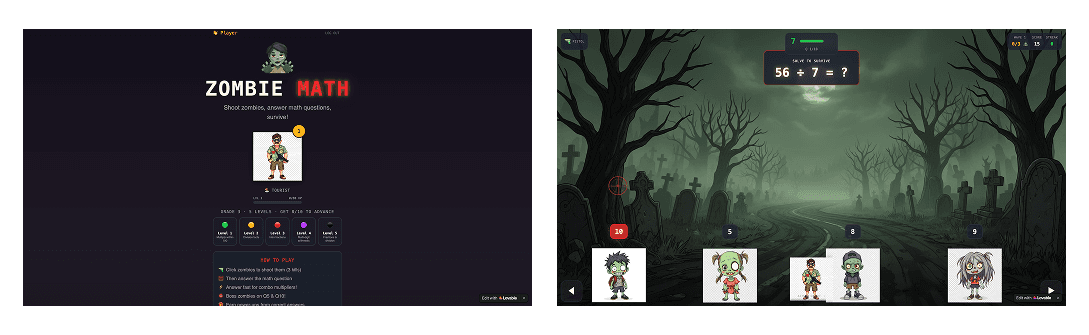
Zombie Math: a student-built game where players answer division problems to shoot zombies. This game won Best Math Game Design as voted on by the audience at the public showcase.
What we learned
1. Students took real ownership of their games
Students invested significant time into building their games, both during sessions and at home. Students were given a monthly limit of 100 credits (approx. 1 credit per message), and two students hit their limit and reached out to us to ask for more. Some reported wishing that the internship were longer, one mentioned that he will continue working on his game after the internship was over, and the majority of students said the program increased their interest in both game design and math.
One student put it simply: “Ever since I joined the internship, I learned how to ask AI to make my math game so students could have fun. It was also fun for me because brainstorming ideas makes me want to use Lovable more often and make games that students and I can be more sharp.”
2. Students went beyond what we taught
What surprised us was that as students became more comfortable with Lovable, some started using it as a thinking partner rather than just as a tool to build their games. One asked: “Do you think kids would enjoy this game?” Another pushed back on their own design: “I don't like this because I feel like there's not enough math.” Those moments of game revision and reflection may be where the deepest learning happened.
Students made different versions of their game for beginner versus advanced players. One student wrote "for different grade levels, make sure that the level gets higher and lower". They were trying to align their game with real grade-level standards without being asked. Another student even made an extra easy version of her game so her younger sibling could play as well.
3. Where students needed support
The first challenge was AI literacy. Students often didn’t provide enough context for Lovable to execute what they had in mind. Once we brought in a guest speaker to explain how AI processes instructions and gave students a prompt engineering template, the quality of their prompts improved noticeably.
The second challenge was math integration. Students made genuinely creative games, but in many cases the math sat on top of the game rather than being built into it. Two students cracked this: one built an RPG where players calculate and compare the areas of shapes to cast spells and defeat enemies, and another built a town simulation where you used math to decide what to buy at the grocery store. For future iterations, we want to build in more scaffolding to help students design games where math is a game mechanic.
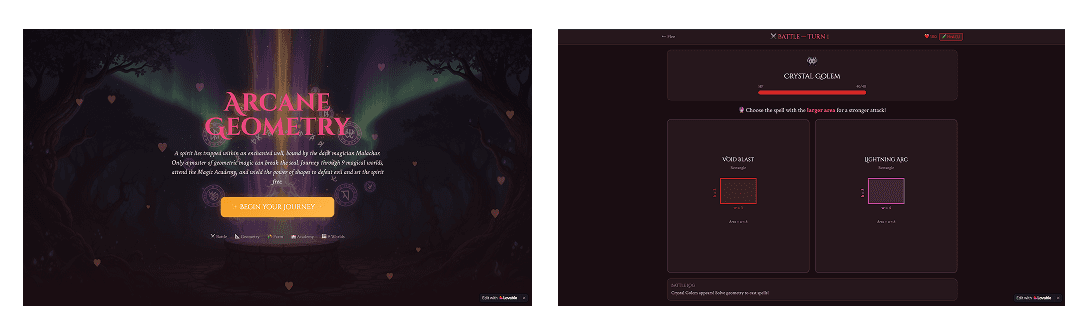
Arcane Geometry: a student-built RPG where players solve area problems to cast spells and defeat enemies.
What’s next
We're exploring how this program could work inside classrooms and after-school programs more broadly. The Mathly team has been experimenting with something similar: giving students the opportunity to create their own games once they've completed their in-class work.
What this program showed us is simple: give students genuine agency over their learning, and they show up differently. They spent time building their games at home, pushed back on their own designs, and thought carefully about who their games were for.
Game design is just one approach. As AI tools make building more accessible, there’s a broader opportunity to rethink what student ownership can look like in a classroom: not just who plays, but who creates, who designs, and who makes decisions.